CTG Insights Exchange Series
Frontier AI Models: The Future of Cybersecurity and Prospects for Government Information Technology

CTG Insights Exchange Opens a Timely Conversation on AI, Cybersecurity, and Government Capacity
As AI potentially increases the speed of both cyber-attacks and cyber-defense, how can public institutions build the capacity to govern, respond, learn and continue delivering public services?
On September 30, 2026, the Center for Technology in Government (CTG) at the University at Albany held the first session of the new CTG Insights Exchange Series, titled “Frontier AI Models: The Future of Cybersecurity and Prospects for Government Information Technology.” The virtual panel brought together Sanjay Goel from the University at Albany, Jason Healey from Columbia University, Ben Spear from the New York State Board of Elections and Theresa Pardo from the University at Albany. Rey Koslowski from the University at Albany moderated the discussion and CTG Research Director Mila Gascó-Hernández opened the event.
The panel explored the growing connection between artificial intelligence (AI) and cybersecurity. The conversation started with the capabilities of frontier AI models and AI agents, before extending to broader questions for government capacity, governance, and resilience.
AI is changing both sides of cybersecurity. AI agents can help identify software vulnerabilities, detect threats, test systems, analyze large amounts of information and support digital forensics. These capabilities can make cybersecurity work faster and more effective than ever. At the same time, many of these same capabilities can also be used to discover and exploit weaknesses in information systems. Healey described one possible approach as creating a “happy path” for AI use. Instead of only telling employees what they cannot do, organizations can create approved ways for them to use AI safely. This can reduce ungoverned uses of AI while allowing organizations to benefit from the technology. The larger challenge, then, is not whether government should use AI or defend itself from AI. Governments increasingly need to do both at the same time.
Key Insights
One theme appeared throughout the discussion: speed.
AI can find vulnerabilities faster, process larger volumes of information, support continuous testing of systems rather than periodic reviews, and eventually help organizations patch vulnerabilities more quickly as well. At the same time, these capabilities can increase the speed of attacks. A vulnerability that once seemed difficult to exploit may become more dangerous when an AI system can instantly connect it with other weaknesses. Organizations may therefore face more vulnerabilities and have less time to decide which ones need immediate attention.
This creates a fundamental tension for government. Technology can change very quickly, while public organizations operate through laws, budgets, responsibilities, approval processes, and existing infrastructure that cannot always change at the same speed. Spear illustrated this problem through election security. Election systems operate within strict rules, certification requirements and fixed election schedules. Some systems have also been in use for many years. Even when new technology makes a weakness easier to identify, election administrators cannot simply change critical systems immediately.
The lesson is not that government should try to make every decision as quickly as an AI system. Government has good reasons for testing, oversight, accountability, and careful decision making. The challenge is to build institutions that can respond to rapid technological change without giving up these public responsibilities.
This leads to a second and deeper issue: governance.
Pardo suggested that “the biggest cybersecurity challenge of the AI era” may not be protecting government from AI, but “governing a government that increasingly relies on AI.” When AI systems can analyze information, recommend decisions, or take actions with less direct human involvement, cybersecurity is no longer only about keeping an outside attacker away from government systems. Public organizations also need to decide how their own AI-enabled systems should behave.
What information should an AI agent be allowed to access? What actions can it take on its own? Who is responsible when it acts? How much authority should cybersecurity leaders have? How should these responsibilities be established across agencies and levels of government? These are not only technical questions. They are questions about authority, responsibility, law, management, and risk. This also helps explain why AI governance cannot be separated from cybersecurity. A technically powerful security tool is not enough if an organization has not decided who can use it, what it can do, and what level of risk is acceptable.
A third insight from the discussion concerns resilience.
Cybersecurity often focuses on preventing attacks and fixing vulnerabilities. These activities remain essential. But an environment shaped by AI may make it increasingly difficult to assume that every disruption can be prevented. For government, this matters because a cyber incident is not only an information technology problem. Government information systems support elections, emergency services, public health, water systems, benefits and many other services people depend on. Pardo therefore emphasized resilience, including the ability to anticipate disruption, withstand it, recover from it, and adapt afterward.
This changes the question from only “How do we prevent an attack?” to also asking “Can government continue to perform its mission when something goes wrong?” That shift has practical consequences. Governments need strong defenses, but they also need recovery plans, clear responsibilities, reliable backups, coordination mechanisms, and the ability to learn from incidents. In an environment where technology and threats continue to change, resilience becomes part of cybersecurity rather than simply a response after cybersecurity fails.
The panel also raised an important question about where cybersecurity capacity comes from. Government organizations have very different resources. A large state agency may have specialized cybersecurity staff and access to advanced technology. A small local government may have only a few employees and depend heavily on outside vendors.
Expecting every organization to build the same AI and cybersecurity capabilities is therefore unrealistic.
The discussion pointed toward a broader model of capacity. States can support local governments. Larger governments can share expertise. Professional associations can connect practitioners and spread knowledge. Universities and organizations such as CTG can help translate research into practice. Vendors also play an important role because many governments depend on systems they do not build themselves. This leads to another insight: in an AI-enabled environment, cybersecurity capacity may increasingly be a property of networks, not only individual organizations.
Pardo captured an important part of this challenge by asking, “Who is the we?” When we say that “we” need to prepare for AI-related cyber risks, that group may include state agencies, local governments, federal partners, critical infrastructure providers, vendors, researchers and professional communities. Effective governance requires not only identifying these actors, but also deciding how they share responsibilities, information, resources and risk.
Lessons for Government Capacity in the AI Era
The panel discussion suggests that the deeper challenge created by AI is not simply a new generation of cyber threats. It is a challenge of adaptive government capacity. Readiness may therefore be less about reaching a fixed level of technological expertise and more about building institutions that can continue to learn, coordinate and adapt as technology changes.
The discussion about workforce development and organizational learning reinforced this point. Goel emphasized the need to give employees time to learn new technologies, while Pardo and Spear discussed learning as part of organizational practice and professional networks. In a rapidly changing environment, government capacity depends not only on existing expertise, but also on the ability to continuously develop, apply, and share new knowledge.
A related challenge is translating that knowledge into administrative action. Technical experts may understand how AI is changing cybersecurity, but public leaders still need to turn that knowledge into decisions about authority, staffing, training, resources, risk and service delivery. Broad principles can provide direction, but public managers also need practical guidance about what to do next. From this perspective, preparing government for AI is not only about adopting new technology. It is about developing the institutional capacity to continuously learn, adapt and translate technological change into responsible public action.
Looking Ahead: What Should Governments Consider Next?
AI is accelerating the pace of technological change. However, public institutions cannot respond to that change through speed alone. At the same time, they must build the capacity to manage risk and adapt while maintaining accountability, continuity of public services, and public value. The central challenge, therefore, is to preserve these responsibilities while strengthening the ability to respond, learn, and adapt more quickly.
As a result, an important question remains: As AI systems become faster and more autonomous, how can governments build institutions that are not only secure and resilient today, but also capable of continuously learning, adapting, and serving the public tomorrow? This timely discussion highlights the urgency of addressing that question as governments navigate the next phase of AI-enabled transformation.
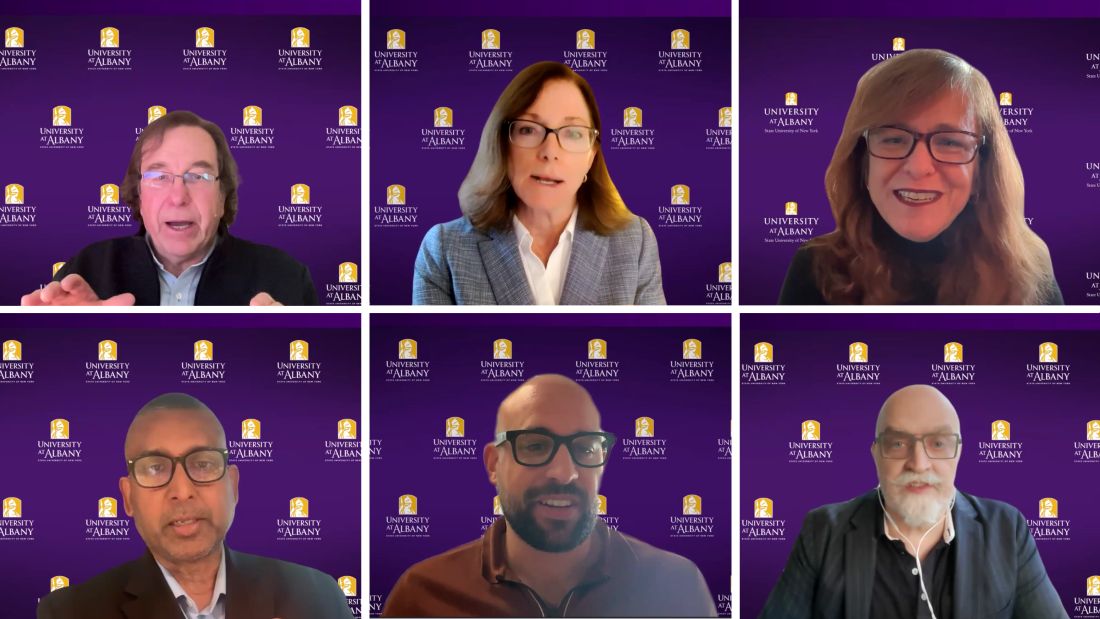
About Panelists
Sanjay Goel | Morris Massry Endowed Professor, University at Albany, State University of New York
Sanjay Goel is a Morris Massry Endowed Professor in the Massry School of Business at the University at Albany and Director of Research at the New York State Center for Information Forensics and Assurance. His research focuses on cybersecurity, cyber warfare, malware and botnets, risk analysis, security policy, and complex self-organizing systems. He has published more than 50 refereed articles and delivered numerous keynote and plenary talks internationally. Goel has contributed to major cybersecurity initiatives with organizations including IEEE, OSCE, and New York State agencies. His work has received substantial external funding, and he has earned multiple awards for research, teaching, mentoring, and innovation.
Jason Healey | Senior Research Scholar, Columbia University
Jason Healey is a Senior Research Scholar at Columbia University’s School for International and Public Affairs specializing in cyber risk and conflict. Jason was a founding member of both the Office of the National Cyber Director at the White House (2022) and the first cyber command in the world, the Joint Task Force for Computer Network Defense in 1998. He created Goldman Sachs’ first capabilities for cyber incident response and threat intelligence and later oversaw the bank’s crisis management and business continuity in Asia. He served as the vice chair of the Financial Services Information Sharing and Analysis Center (FS-ISAC) and is a review board member of the DEF CON and Black Hat security conferences.
Ben Spear | Chief Infrastructure & Security Officer for the NYS Board of Elections and Director of ITS Secure Elections Center, New York State Board of Elections
Ben Spear serves as Chief Infrastructure & Security Officer for the New York State Board of Elections and Director of its Secure Elections Center. This cross functional team of security and election experts secures the State Board and election technology, while advancing cybersecurity maturity for 58 city and county boards of elections through best practice guidance, security grant funding, and shared services. As founding Director of the Election Infrastructure Information Sharing and Analysis Center (EI-ISAC), Ben collaborated with federal partners and over 3,000 state and local election offices to secure the 2018-2020 elections through a combination of technology solutions and intelligence sharing. He remains actively involved as a state IT representative on the ISAC’s Executive Committee. After nearly 20 years in state and federal homeland security roles, Ben leverages his unique blend of political and technical experience to translate complex threats into actionable strategies and establish a proactive defensive culture.
Theresa Pardo | Associate Vice President for Research and Special Assistant to the President at the University at Albany, University at Albany, State University of New York
Theresa A. Pardo is Associate Vice President for Research and Special Assistant to the President at the University at Albany, where she leads strategic research initiatives and interdisciplinary collaborations. She is also a Research Professor in the Rockefeller College of Public Affairs and Policy and a Senior Fellow at the Center for Technology in Government (CTG). A globally recognized scholar in digital government, public sector innovation, and technology-enabled governance, Dr. Pardo previously served as CTG Director from 2009 to 2021, helping establish the center as an international leader in digital transformation research and practice. She has authored more than 250 publications, is a Fellow of the National Academy of Public Administration, and has received numerous honors for her research, leadership, and contributions to public service innovation.
Mila Gascó-Hernández | Research Director, Center for Technology in Government & Professor at Rockefeller College, University at Albany, State University of New York
Mila Gascó-Hernández is the Research Director at the Center for Technology in Government and also a Professor at Rockefeller College of Public Affairs & Policy. Mila comes from the Center for Public Governance at ESADE Business & Law School in Barcelona, where she was a senior researcher leading the center’s research on e-governance, open government, and smart cities. She has an extensive advising and teaching background, having worked for a wide variety of organizations including the United Nations’ Development Program, the Office of the Mayor of Valencia, Valenzuela, the Spanish Agency for International Development, the International Institute for Democracy and Electoral Assistance, and many others. She is a recipient of the Entric Prat de la Riba award, which is granted by the School of Public Administration of Catalonia to the author of the top thesis on public management and administration. She has taken part in numerous national and international seminars/conferences and regularly publishes in both English and Spanish.
Rey Koslowski | Professor of Political Science·University at Albany, State University of New York
Rey Koslowski is Professor of Political Science, University at Albany. His books include Migrants and Citizens: Demographic Change in the European States System (2000), International Migration and the Globalization of Domestic Politics (2005) and Global Mobility Regimes (2011). Koslowski has extensively published on the relationship of information technology and international migration, including Real Challenges for Virtual Borders: The Implementation of US-VISIT (2005), Battle for the Brains: Why Immigration Policy is not Enough to Attract the Highly-Skilled (2009), “Shifts in Selective Migration Policy Models: a Comparison of Australia, Canada, and the United States” (2018), “Drones and Border Control” (2021) and “Selective Migration Policies with Chinese Characteristics” (2024). Koslowski’s project as a faculty fellow of UAlbany’s AI and Society College, was entitled “Artificial Intelligence, Migration Management and US-China Competition,” which he presented at the 2025 American Political Science Association Meeting (APSA).